
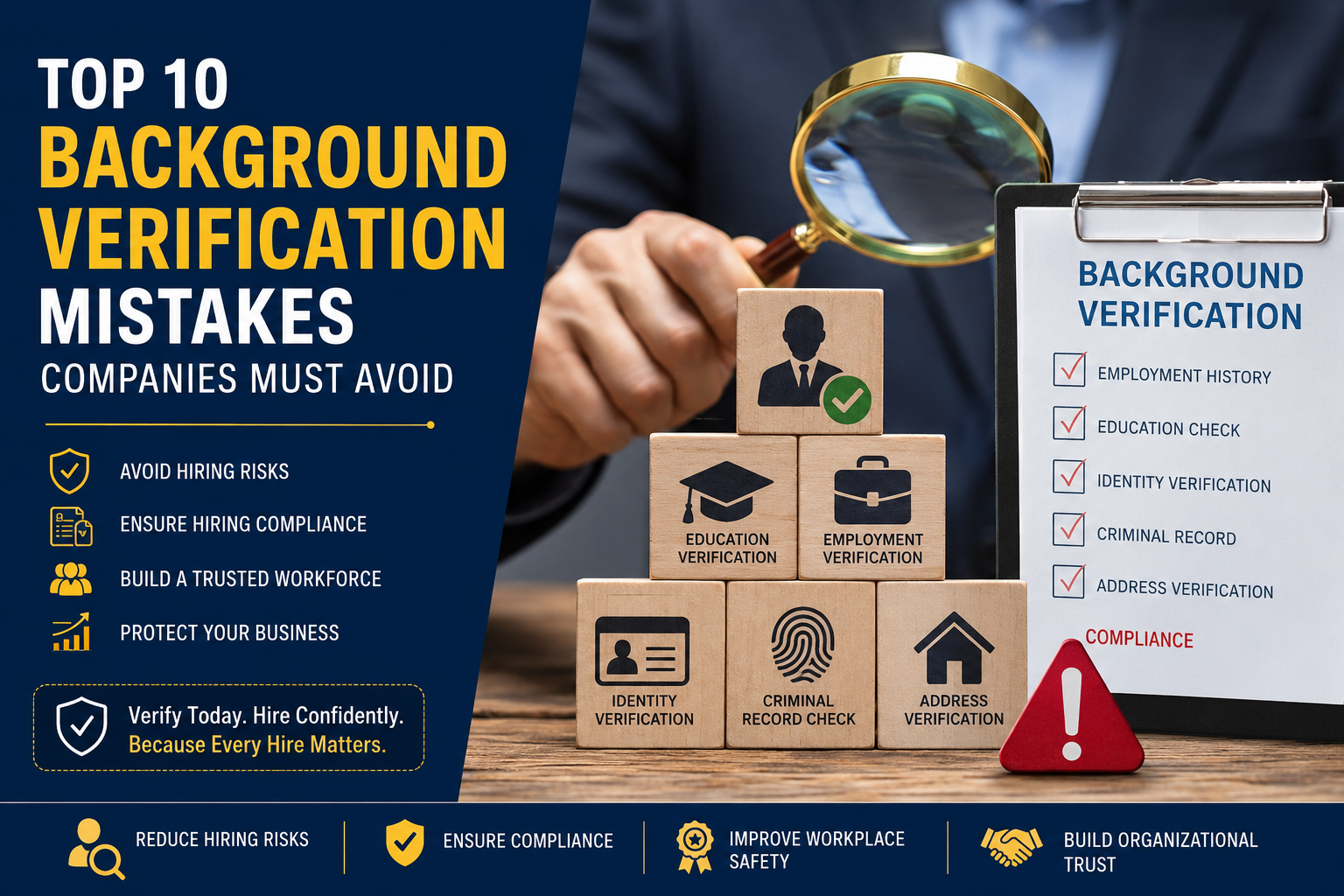
Hiring is never just about filling a position—it’s about protecting the future of your business. One wrong hire can quietly drain productivity, damage team morale, or in worst cases, expose the company to financial and legal risks.
Despite this, many organizations still treat background verification as a routine checkbox rather than a critical risk management function. This is where most background verification mistakes begin.
In a business environment where hiring compliance is becoming stricter and more scrutinized, companies can’t afford a weak or inconsistent verification process. This article walks you through the most common background verification mistakes companies make during background verification process—and how to avoid them in a practical, real-world way.
Why Background Verification Still Gets Overlooked
On paper, background verification sounds straightforward: verify education, check employment history, confirm identity. But in practice, it’s rarely that simple.
Tight hiring timelines, pressure from hiring managers, and lack of standardized processes often lead to shortcuts. These shortcuts are exactly what create long-term problems.
A strong verification process doesn’t just confirm facts—it gives you confidence in your hiring decisions.
Top 10 Background Verification Mistakes:
1. Assuming Senior Candidates Don’t Need Verification
There’s a common but risky assumption that experienced professionals—especially those applying for leadership roles—don’t require detailed checks.
In reality, the stakes are higher with senior hires. They handle sensitive data, influence strategic decisions, and represent the company externally. A single mis-judgment here can have far-reaching consequences.
Better approach: Treat every hire, regardless of designation, with the same level of verification rigor.
2. Taking Candidate Information at Face Value
Many companies still rely heavily on resumes, documents, and references provided directly by candidates. While this is a starting point, it shouldn’t be the only source of truth.
References can be selective. Documents can be altered. Even small discrepancies, if ignored, can point to larger issues.
Better approach: Cross-verify information through independent channels—previous employers, universities, and verified databases.
3. Limiting Verification to Basic Checks
Another frequent oversight is restricting verification to just employment and education. While these are important, they don’t give you the full picture.
Depending on the role, additional checks like criminal records, address verification, or financial background may be equally critical.
Better approach: Build a role-based verification framework. A finance role, for example, should not have the same verification depth as a junior operational role.
4. Overlooking Hiring Compliance
Compliance isn’t just a legal formality—it’s the backbone of ethical hiring. Ignoring hiring compliance can lead to serious consequences, including legal notices, fines, and reputational harm.
This often happens when companies rush through the process without proper documentation or consent.
Better approach:
- Always obtain written consent before initiating checks
- Follow data protection laws
- Maintain transparency with candidates
5. Starting Verification Too Late
Some organizations wait until after onboarding to begin background checks. This creates unnecessary risk.
If discrepancies show up later, reversing the hiring decision becomes complicated and sometimes legally sensitive.
Better approach: Start verification early—ideally during the offer stage or while the candidate is serving their notice period.
6. Operating Without a Standard Process
When there’s no clear framework, verification becomes inconsistent. One candidate may go through detailed checks, while another might barely be reviewed.
This inconsistency increases risk and reduces accountability within HR teams.
Better approach:
Create a structured process that includes:
- Defined verification steps
- Standard checklists
- Clear approval workflows
7. Trying to Handle Everything Internally
While it may seem cost-effective to manage verification in-house, it often leads to delays and gaps due to limited resources and access.
Internal teams may not have the tools or networks required for deep verification, especially for cross-location or international checks.
Better approach: Work with a professional background verification partner who specializes in accuracy, speed, and compliance.
8. Ignoring Warning Signs
In the rush to close positions, red flags are sometimes overlooked or downplayed. This is one of the most dangerous employee verification mistakes.
Common warning signs include unexplained employment gaps, mismatched roles, or inconsistent feedback from previous employers.
Better approach: Treat every discrepancy seriously. Even minor inconsistencies deserve clarification before proceeding.
9. Poor Record Keeping
Verification doesn’t end with completing checks—it also involves maintaining proper records.
Without documentation, companies struggle during audits or legal reviews. It also becomes difficult to track past decisions or defend hiring actions.
Better approach: Maintain organized and secure records of:
- Verification reports
- Candidate consent forms
- Communication history
10. Treating Verification as a One-Time Activity
Many companies view background verification as something that happens only before hiring. But risks don’t disappear after onboarding.
Employee behavior, responsibilities, and access levels evolve over time.
Better approach: Introduce periodic checks, especially for roles involving finance, data security, or compliance-sensitive responsibilities.
How to Build a Strong Verification Process
Avoiding background verification mistakes is one part of the equation—building a reliable system is the other.
- Define a Clear Policy: Outline what needs to be verified, for which roles, and at what stage of hiring.
- Use Technology Where It Matters: Automation can reduce manual errors and speed up the process, especially for identity and database checks.
- Train Your HR Team: Your process is only as strong as the people implementing it. Make sure HR teams understand both risk and compliance aspects.
- Keep the Candidate Experience in Mind: Verification shouldn’t feel intrusive or confusing. Clear communication builds trust and improves employer branding.
Common Background Verification Mistakes vs Their Impact
| Mistake | Business Impact |
| Skipping verification | Higher risk of fraudulent hires |
| Incomplete checks | Security and operational risks |
| Ignoring compliance | Legal penalties and reputation loss |
| Delayed verification | Hiring disruptions |
| Poor documentation | Audit and legal challenges |
Why Hiring Compliance Should Be a Priority
Hiring compliance isn’t just about avoiding penalties—it’s about building a responsible organization.
When companies follow proper verification practices, they create a culture of transparency and accountability.
Key areas to focus on include:
- Data privacy and protection
- Candidate consent
- Fair hiring practices
- Regulatory adherence
Organizations that prioritize compliance not only reduce risk but also strengthen their credibility in the market.
Conclusion
Background verification is often underestimated until something goes wrong. By then, the cost—financial, legal, or reputational—is already high.
Avoiding these background verification mistakes isn’t about adding complexity to your hiring process; it’s about making smarter, more informed decisions.
A structured, compliant, and well-executed verification strategy helps you hire with confidence and build a workforce you can truly rely on.
Visit the Dcode Research Pvt. Ltd.
Frequently Asked Questions:
1. What are the most common employee verification mistakes?
Common mistakes include skipping verification for senior roles, relying only on candidate-provided data, conducting incomplete checks, and ignoring compliance requirements.
2. Why is hiring compliance important in background verification?
Hiring compliance ensures that verification processes are legally sound and ethically conducted, helping organizations avoid legal issues and maintain credibility.
3. When should background verification be conducted?
Ideally, background verification should begin during the offer stage or while the candidate is serving their notice period, before final onboarding.
4. Is background verification necessary for small businesses?
Yes, hiring risks exist regardless of company size. Even small businesses can face serious consequences from a wrong hire.
5. How can companies improve their verification process?
Companies can improve by standardizing their process, using reliable verification partners, leveraging technology, and ensuring compliance with regulations.