
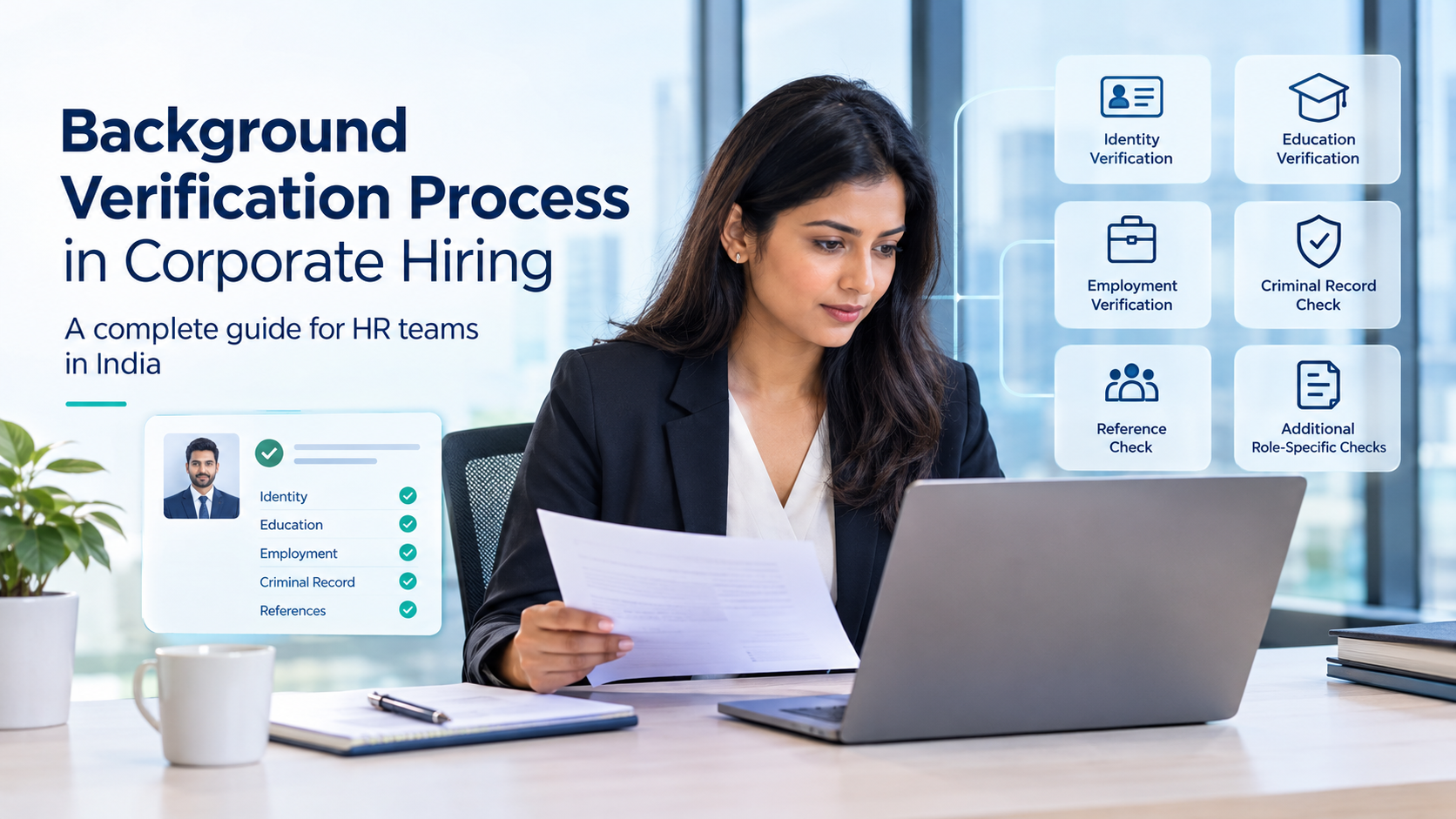
Why Background Verification Matters in Corporate Hiring
Recruiting the right employees is one of the most important responsibilities of any organisation. While qualifications, professional experience, technical expertise, and interview performance help employers evaluate candidates, these factors alone may not provide a complete picture of an individual’s professional history.
In today’s competitive hiring environment, organisations must also establish whether the information provided by candidates is accurate, consistent, and appropriate for the responsibilities of the position. This is where employee background verification (BGV) becomes an essential part of the corporate recruitment process.
From IT companies hiring software engineers to banks recruiting financial professionals, hospitals onboarding healthcare personnel, and manufacturing companies appointing plant managers, background verification helps employers make informed recruitment decisions.
The need for structured verification has become more evident as companies adopt remote hiring, expand across geographical boundaries, work with third-party staffing agencies, and recruit employees with diverse educational and professional backgrounds.
A May 2026 report published by Business Standard, citing a Genius HRTech survey of 1,647 HR professionals and business leaders, reported that 57% of respondents believed organisations frequently compromised background verification standards to meet faster hiring timelines. This highlights an important challenge for modern HR teams: maintaining recruitment speed without weakening due diligence. Source: Business Standard, May 2026.
For organisations operating in India, a well-defined BGV process can support hiring integrity, protect sensitive information, reduce avoidable recruitment risks, and strengthen trust between employers, employees, customers, and business partners.
This guide explains the complete background verification process, the checks involved, industry-specific requirements, modern verification technologies, and best practices for corporate HR teams.
What Is Background Verification in Corporate Hiring?
Background verification is a structured process through which an employer, or an authorised verification service provider acting on the employer’s behalf, validates relevant information about a prospective employee.
The objective is to establish whether the candidate’s identity, educational qualifications, employment history, address details, professional credentials, and other role-relevant information are supported by reliable evidence.
The exact scope of verification depends on the position, industry, applicable laws, contractual obligations, and the organisation’s internal policies.
For example, a graduate trainee may require identity, education, address, and employment checks where applicable. A finance manager handling sensitive financial information may require additional scrutiny of professional credentials and other legally permissible, role-relevant records.
Similarly, an employee joining a technology company with access to confidential client systems may require verification procedures aligned with the organisation’s information security requirements.
Background verification is not simply a search for negative information. It is a process for validating facts, identifying material inconsistencies, and enabling fair, evidence-based hiring decisions.
Why Is Background Verification Important for Corporate Organisations?
A systematic BGV process benefits organisations in several ways.
- Validating Candidate Information
Resumes and job applications contain information supplied by candidates. Verification helps confirm essential details such as previous employment, educational qualifications, designations, and employment dates.
This is particularly important when candidates apply for positions requiring specialised expertise, professional licences, or substantial industry experience.
- Reducing Employment Fraud Risks
Misrepresentation can take different forms, including fabricated employment history, altered educational documents, inflated job titles, undisclosed overlapping employment periods, or inaccurate professional credentials.
Verification helps identify discrepancies before they create larger recruitment or operational problems.
- Protecting Business Information and Assets
Employees may have access to customer records, intellectual property, financial information, proprietary systems, and confidential business strategies.
Role-appropriate verification forms one layer of an organisation’s broader risk management framework. It should complement, rather than replace, access controls, cybersecurity measures, employee training, and internal governance.
- Supporting Client and Regulatory Requirements
Organisations serving regulated industries or enterprise clients may be required by contracts, sector-specific rules, or internal policies to complete certain checks before onboarding employees.
For example, a company deploying personnel to a client environment may need documented evidence that agreed verification requirements have been completed.
The applicable requirements should be confirmed for each industry, contract, and job category rather than assumed to be identical across all employers.
- Improving Recruitment Quality
When HR teams have access to reliable verification results, they can evaluate candidates with greater confidence and make decisions based on documented evidence.
A consistent process also helps reduce last-minute surprises, repeated document requests, and delays caused by incomplete information.
The Complete Background Verification Process: Step by Step
A corporate BGV process should follow a consistent workflow while allowing flexibility according to the role and level of risk.
Step 1: Define the Verification Scope
The first step is to identify the checks required for the position.
HR teams should consider:
- The responsibilities and seniority of the role.
- Access to confidential information, money, or sensitive systems.
- Industry-specific regulations and client requirements.
- The candidate’s employment and educational history.
- The geographical locations in which the candidate has studied or worked.
- The organisation’s recruitment and data protection policies.
For example, an entry-level marketing executive and a senior finance controller may require different verification packages.
A risk-based approach prevents organisations from applying unnecessarily intrusive checks to every candidate while ensuring that critical roles receive appropriate scrutiny.
Step 2: Obtain Candidate Information and Appropriate Consent
Once the scope is established, the organisation collects the information and documents needed to conduct the selected checks.
Depending on the requirements, these may include:
- Candidate application details.
- Government-issued identity documents.
- Address information.
- Educational certificates and details of awarding institutions.
- Previous employer names and employment periods.
- Professional licence or certification details.
- Reference contact information.
Candidates should receive a clear explanation of the verification process, including its purpose, the categories of information involved, and the parties responsible for processing the information.
Employers should establish a legally appropriate basis for processing personal data and obtain valid consent where required. They should also provide a process for correcting inaccurate information.
Step 3: Identity Verification
Identity verification establishes whether the information provided by the candidate corresponds with reliable identity records.
Depending on the role and applicable requirements, verification may involve permitted checks of PAN, Aadhaar-related information, passports, or other accepted identity documents.
Digital identity verification can also incorporate document authentication, data consistency checks, and authorised electronic verification methods.
However, employers should collect only the identity information necessary for the stated purpose. Aadhaar authentication and access to government identity databases must not be assumed to be universally available to private employers.
Step 4: Address Verification
Address verification helps establish whether the candidate’s declared residential details can be reasonably substantiated.
Common methods include:
- Document-based address checks.
- Verification against permissible records.
- Digital or video-assisted verification.
- Other proportionate methods appropriate to the role and circumstances.
Address verification may be relevant for employees working in sensitive environments, positions with specific contractual requirements, or roles requiring additional identity assurance.
An address discrepancy does not automatically indicate fraud. Relocation, outdated documents, rental arrangements, and recent changes of residence can all explain differences. HR teams should review the available evidence before drawing conclusions.
Step 5: Education Verification
Education verification confirms the qualifications that candidates claim to possess.
The process may include checking:
- University or college names.
- Degrees, diplomas, and certifications.
- Dates of enrolment and completion.
- Specialisations or professional qualifications.
- The authenticity of relevant certificates and records.
Where feasible, verification should be completed through the issuing institution or an authorised verification channel.
Digital academic records, including records available through DigiLocker or other authorised platforms, may support verification where the relevant institution, document, and access mechanism are supported.
Education checks are especially relevant for engineering, healthcare, finance, legal, research, and other specialised positions where qualifications influence eligibility or professional competence.
If an institution does not respond, HR teams should distinguish an unverified qualification from a qualification confirmed to be false. Alternative evidence and reasonable follow-up may be necessary.
Step 6: Previous Employment Verification
Employment verification helps confirm the candidate’s professional history.
Typical checks include:
- Previous employer names.
- Employment start and end dates.
- Designation or job title.
- Employment status, where confirmable.
- Other relevant employment details supported by authorised records.
With suitable authorisation and access, additional evidence may include employment letters, relieving letters, experience certificates, or permitted employment records.
Employment verification is particularly important for experienced professionals, senior managers, client-facing employees, and individuals recruited for specialised responsibilities.
Some employers provide only limited confirmation because of internal policies. In such situations, verification providers may use alternative evidence and clearly document any limitations.
An unsuccessful verification attempt is not the same as a failed background check. HR teams should examine the reason for the gap before deciding whether further evidence is needed.
Step 7: Criminal Record and Court Record Checks
Criminal and court record checks may help employers assess risks relevant to specific positions.
Depending on the scope and applicable law, the process may involve searches of accessible court records, relevant public records, or other legally permissible sources.
These checks require careful interpretation. Name similarities, incomplete records, outdated information, and cases involving individuals with similar identities can lead to incorrect matches.
A responsible process should therefore:
- Use appropriate identifiers to distinguish individuals.
- Verify the accuracy and relevance of potential matches.
- Distinguish allegations, pending proceedings, and convictions.
- Give candidates a reasonable opportunity to clarify material findings.
- Consider applicable laws and the actual requirements of the role.
Employers should not assume that every pending case proves misconduct or that a record automatically disqualifies a candidate from every position.
The objective is to make a lawful, proportionate, evidence-based assessment rather than rely on unverified database results.
Step 8: Reference Verification
Reference verification provides additional context about a candidate’s professional conduct and work history.
Depending on the role, HR teams may contact former supervisors, reporting managers, or other appropriate professional references.
Questions may address the nature of the working relationship, responsibilities performed, professional strengths, and other job-related matters.
For senior positions, structured references may help assess leadership, decision-making, team management, and professional integrity.
Reference checks should be conducted transparently and proportionately. Employers should avoid unnecessary disclosure of a candidate’s job search to current employers or other third parties.
Step 9: Additional Role-Specific Checks
Some corporate roles require additional checks beyond standard identity, education, and employment verification.
These may include:
Professional licence verification: Relevant for healthcare professionals, chartered accountants, lawyers, engineers in regulated functions, and other licensed occupations.
Financial integrity checks: Where legally permissible and relevant to the position, additional financial checks may be considered for certain finance, treasury, or fiduciary responsibilities.
Directorship and corporate record checks: Potentially relevant for executive appointments, board positions, and senior leadership roles.
International verification: May be needed when a candidate has studied or worked overseas. The process depends on the country, source availability, local privacy requirements, and response timelines.
Conflict-of-interest checks: Relevant where an employee’s outside business interests or other relationships could materially conflict with the responsibilities of the position.
Public professional footprint checks: Relevant, publicly available professional information may be reviewed for certain roles, subject to applicable law, fairness, and relevance.
These additional checks should not be treated as mandatory for every employee. The scope should be justified by the role and documented in the verification policy.
Step 10: Consolidate Results and Review Discrepancies
Once the checks are completed, the verification provider consolidates the findings into a report for the authorised employer.
The report should clearly distinguish between:
- Verified information.
- Discrepancies requiring review.
- Information that could not be verified.
- Checks that remain pending.
- Findings requiring clarification or additional evidence.
HR teams should evaluate each finding according to its reliability, relevance, severity, and potential impact on the job.
For example, a minor variation in an employment date may have a straightforward explanation. A qualification that is material to the position and confirmed to be fabricated may require a more serious review.
Before making an adverse hiring decision, the employer should give the candidate a reasonable opportunity to explain material discrepancies and correct inaccurate information.
Step 11: Make the Final Hiring Decision
The final recruitment decision rests with the employer, not merely with the verification provider.
HR, the hiring manager, and other authorised stakeholders should consider the findings alongside the candidate’s qualifications, interview performance, job requirements, and applicable policies.
The decision should be documented, consistent with the organisation’s standards, and proportionate to the evidence.
Step 12: Maintain Records and Close the Process
The final step is to record the verification outcome, resolve outstanding items, and maintain the necessary documentation under the organisation’s retention and access policies.
Only authorised personnel should have access to sensitive reports. Information should be retained only for appropriate, legally permitted periods and protected against unauthorised disclosure.
A documented closure process helps organisations maintain accountability and prepare for legitimate internal or contractual audits.
Types of Background Verification Required Across Corporate Industries
Different industries have different operational risks. Consequently, a standard verification package may not be suitable for every organisation.
| Industry | Commonly relevant verification checks |
| IT and IT-enabled services | Identity, education, employment, address, references, and client-required checks |
| Banking, financial services, and insurance | Identity, employment, qualifications, role-relevant financial checks, and applicable regulatory requirements |
| Healthcare and pharmaceuticals | Identity, education, professional registration or licences, employment, and role-appropriate additional checks |
| Manufacturing and engineering | Identity, technical qualifications, employment, professional credentials where relevant, and site-specific requirements |
| Retail and e-commerce | Identity, employment, address where justified, and additional checks for sensitive responsibilities |
| Logistics and transportation | Identity, employment, and applicable driving licence or other role-specific authorisations |
| Consulting and professional services | Identity, education, employment, references, and client-specific verification requirements |
| Startups and technology businesses | Identity, qualifications relevant to the role, employment, and proportionate checks for access to sensitive systems or assets |
| Senior leadership and executive hiring | Identity, education, employment, references, directorships, and role-relevant corporate or regulatory checks |
This table is a practical starting point rather than a universal compliance checklist. Each employer should validate the checks against its own industry, job requirements, applicable law, and client obligations.
How Technology Is Transforming Background Verification in 2026
Corporate hiring increasingly depends on digital workflows, distributed teams, and faster recruitment cycles. Verification technology can help reduce manual effort and improve the consistency of checks.
- AI-Assisted Document Analysis
Artificial intelligence and optical character recognition (OCR) can help extract information from submitted documents and identify inconsistencies, missing fields, or potential signs of alteration.
However, automated flags are indicators for further review, not definitive proof of fraud. Human review remains important when records are unclear or a candidate disputes a result.
- Digital Identity and Electronic Records
Digital identity tools and electronic records can make certain verification steps more efficient.
Depending on availability, authorisation, and the applicable process, employers may use supported digital document verification, DigiLocker-based records, or other legitimate electronic verification channels.
The use of these technologies should follow applicable identity, privacy, and security requirements.
- Automated Workflow Management
BGV platforms can help HR teams monitor verification status, send document requests, manage follow-ups, and identify checks that are pending or require intervention.
These capabilities are particularly valuable for companies recruiting large numbers of employees across multiple locations.
- Video-Assisted and Remote Verification
Remote verification workflows can support distributed recruitment by reducing the need for physical interactions.
Appropriate safeguards should be used to validate documents, protect personal information, and prevent impersonation. Video verification should not automatically be treated as equivalent to every form of official identity authentication.
- Fraud Detection and Data Consistency Analysis
Technology can help compare information across documents and identify inconsistencies involving dates, names, designations, or other relevant fields.
For example, an automated system may flag overlapping employment periods or a mismatch between a stated qualification and a submitted certificate.
Such discrepancies require contextual review before an employer concludes that information is false.
- Secure Reporting and Audit Trails
Digital reporting systems can improve traceability by recording verification status, outstanding queries, authorised access, and final decisions.
Organisations should assess vendors for appropriate security controls, access management, data handling practices, and incident response procedures.
Technology improves efficiency, but it does not remove the need for sound policies, reliable sources, and accountable human decision-making.
Background Verification and Data Protection Compliance in India
Employee background verification involves personal information, making data protection an important part of the process.
India’s Digital Personal Data Protection Act, 2023, and the Digital Personal Data Protection Rules, 2025, form a significant part of the country’s evolving personal data protection framework.
The Rules were notified on 14 November 2025, with implementation provisions phased over time. Employers should review the applicable commencement dates and obligations rather than assume that every provision became effective simultaneously. Source: Ministry of Electronics and Information Technology, Press Information Bureau.
For HR teams and BGV providers, responsible practices include the following.
Purpose limitation: Collect information for a defined, legitimate verification purpose and avoid unrelated data collection.
Transparency: Explain the verification process and the categories of personal information involved in clear language.
Appropriate legal basis and consent: Determine the applicable legal basis for processing and obtain consent where required. A generic clause should not replace a proper assessment of the applicable law.
Data minimisation: Collect only information reasonably necessary for the checks being performed.
Security safeguards: Restrict access to verification reports and implement suitable technical and organisational controls.
Retention and deletion: Establish appropriate retention periods and deletion procedures consistent with applicable law and legitimate recordkeeping requirements.
Accuracy and correction: Provide a practical mechanism to investigate disputed information and correct errors.
Vendor governance: Define the responsibilities of employers and verification providers through appropriate agreements and operating procedures.
Organisations should also assess relevant employment laws, sector-specific regulations, client contracts, and other legal requirements that may apply to their operations.
This section is intended as general information, not legal advice. HR leaders should obtain qualified legal guidance when developing or revising their verification policies.
Common Background Verification Challenges Faced by HR Teams
Even a well-designed BGV programme can face operational challenges.
Incomplete Candidate Information: Missing documents, incorrect contact details, or inconsistent dates may delay verification.
Recommended approach: Provide candidates with a clear checklist at the start and use a structured process for requesting missing information.
Delays in Employer and University Responses: Previous employers and educational institutions may take time to respond or may have limited verification facilities.
Recommended approach: Start checks early, use authorised alternative evidence where appropriate, and report unresolved checks transparently.
Hiring Pressure and Tight Joining Deadlines: Recruitment teams may face pressure to onboard employees quickly, particularly for large projects or urgent vacancies.
Recommended approach: Integrate verification into the recruitment workflow and define which checks must be completed before joining and which, where permissible, may be completed later under an approved policy.
False Positives and Identity Mismatches: Similar names, outdated records, and incomplete databases can generate incorrect alerts.
Recommended approach: Use additional identifiers where lawful, validate source records, and provide a candidate clarification process.
Inconsistent Verification Across Locations: Multinational organisations and businesses with multiple offices may apply different verification standards across teams.
Recommended approach: Establish a central BGV policy with role-based verification packages and documented exceptions for local legal requirements.
Privacy and Data Security Risks: Sensitive personal documents and reports can be exposed if access is poorly controlled.
Recommended approach: Work with providers that demonstrate appropriate security practices, restrict access, maintain audit trails, and follow agreed data handling requirements.
Best Practices for Building an Effective Corporate BGV Policy
Organisations can strengthen their verification programmes through a few practical measures.
- Create a role-based verification matrix. Map checks to job responsibilities, industry requirements, and risk levels.
- Standardise the workflow. Define responsibilities, document requirements, timelines, escalation procedures, and report formats.
- Begin verification at the appropriate stage. Where feasible, initiate checks for shortlisted or final candidates early enough to avoid preventable onboarding delays.
- Use reliable verification sources. Prefer issuing institutions, authorised databases, official records, and other dependable sources.
- Separate discrepancies from confirmed misrepresentation. Document the evidence and investigate material differences before deciding.
- Give candidates an opportunity to respond. Establish a fair process for clarifications, corrections, and disputed results.
- Evaluate BGV vendors carefully. Review service scope, turnaround commitments, geographic coverage, quality controls, security practices, and escalation support.
- Monitor process performance. Track completion rates, pending checks, turnaround times, discrepancy resolution, and avoidable delays.
- Train HR teams and hiring managers. Ensure that decision-makers understand the report categories, limitations, and relevant policies.
- Review the policy regularly. Update procedures as technology, hiring practices, industry requirements, and applicable laws evolve.
These measures help organisations create a verification process that is consistent, efficient, proportionate, and aligned with business needs.
Frequently Asked Questions About Background Verification
- What is the background verification process in corporate hiring?
Background verification is the process of validating relevant candidate information before or during onboarding, according to the employer’s policy and applicable requirements. It may include identity, address, education, employment, references, criminal or court record checks, and additional role-specific checks.
- How long does employee background verification take in India?
The turnaround time depends on the number and type of checks, the candidate’s employment and education history, institutional response times, and the availability of records. Straightforward domestic checks may be completed relatively quickly, while overseas verification or delayed institutional responses can extend the timeline. Employers should obtain realistic service-level estimates from their verification provider.
- Is background verification mandatory for every employee in India?
There is no single, universal checklist that applies identically to every private-sector employee and every industry. Requirements may arise from applicable laws, sectoral rules, client contracts, licensing obligations, and company policy. Employers should identify the checks that are appropriate and legally permissible for each position.
- What happens if a candidate fails background verification?
The employer should review the underlying evidence, determine whether the finding is material, and give the candidate an opportunity to explain or correct inaccurate information. A confirmed material misrepresentation may affect the hiring decision, depending on the role and applicable requirements. An incomplete check should not automatically be treated as a failed check.
- Can background verification be conducted online?
Yes. Many verification activities can be conducted through digital document submission, supported electronic records, authorised database checks, and online workflow platforms. Some checks may still require direct institutional confirmation or other methods. The available process depends on the type of record and the relevant source.
- What is the difference between background verification and reference verification?
Background verification is the broader process of validating candidate information, including identity, education, employment, and other relevant records. Reference verification focuses on information and professional insights obtained from people familiar with the candidate’s work. Reference checks complement BGV but do not replace documentary verification.
- Does background verification include criminal record checks?
Criminal or court record checks may form part of a verification package where appropriate and legally permissible. Their scope depends on the position, accessible records, applicable requirements, and the employer’s policy. Potential matches must be validated carefully, and allegations should not be treated as equivalent to convictions.
- How does AI improve background verification?
AI-assisted tools can help extract document information, flag inconsistencies, automate workflows, and prioritise cases for review. They can improve efficiency but may produce errors or false positives. Human oversight, source validation, appropriate privacy controls, and fair decision-making remain essential.
- Why should companies use a professional BGV service provider?
A professional provider can help standardise verification workflows, coordinate checks across locations, manage follow-ups, consolidate findings, and document outcomes. Employers should evaluate the provider’s accuracy, coverage, security practices, transparency, and ability to handle discrepancies before selecting a service partner.
- When should background verification be completed?
The timing should be defined by the organisation’s policy, the nature of the role, and applicable requirements. Many employers begin verification during the final stages of recruitment and require designated checks to be completed before onboarding or access to sensitive systems. The timing should be clearly communicated to candidates.
Conclusion: Making Background Verification an Integral Part of Hiring
Corporate recruitment is not simply about identifying candidates with the right qualifications and experience. It also involves establishing the reliability of the information used to make hiring decisions.
A structured background verification process helps organisations validate candidate credentials, identify material inconsistencies, strengthen recruitment controls, and support responsible onboarding.
As businesses increasingly adopt digital recruitment, remote work, and large-scale hiring, HR teams need verification processes that balance speed, accuracy, fairness, and data protection.
The most effective approach combines role-based verification, reliable information sources, appropriate technology, candidate transparency, and documented decision-making. Background verification should be treated as a component of responsible workforce management rather than a last-minute recruitment formality.
Dcode Research supports organisations with background verification services designed to help HR teams validate candidate information and strengthen their hiring processes. By incorporating structured verification into recruitment workflows, businesses can make more informed decisions and build a stronger foundation of trust across their workforce.
For organisations looking to improve their employee screening and background verification processes, a clearly defined BGV framework is a practical step towards more reliable corporate hiring.
Learn more: Visit Dcode Research to explore background verification solutions for corporate hiring.