
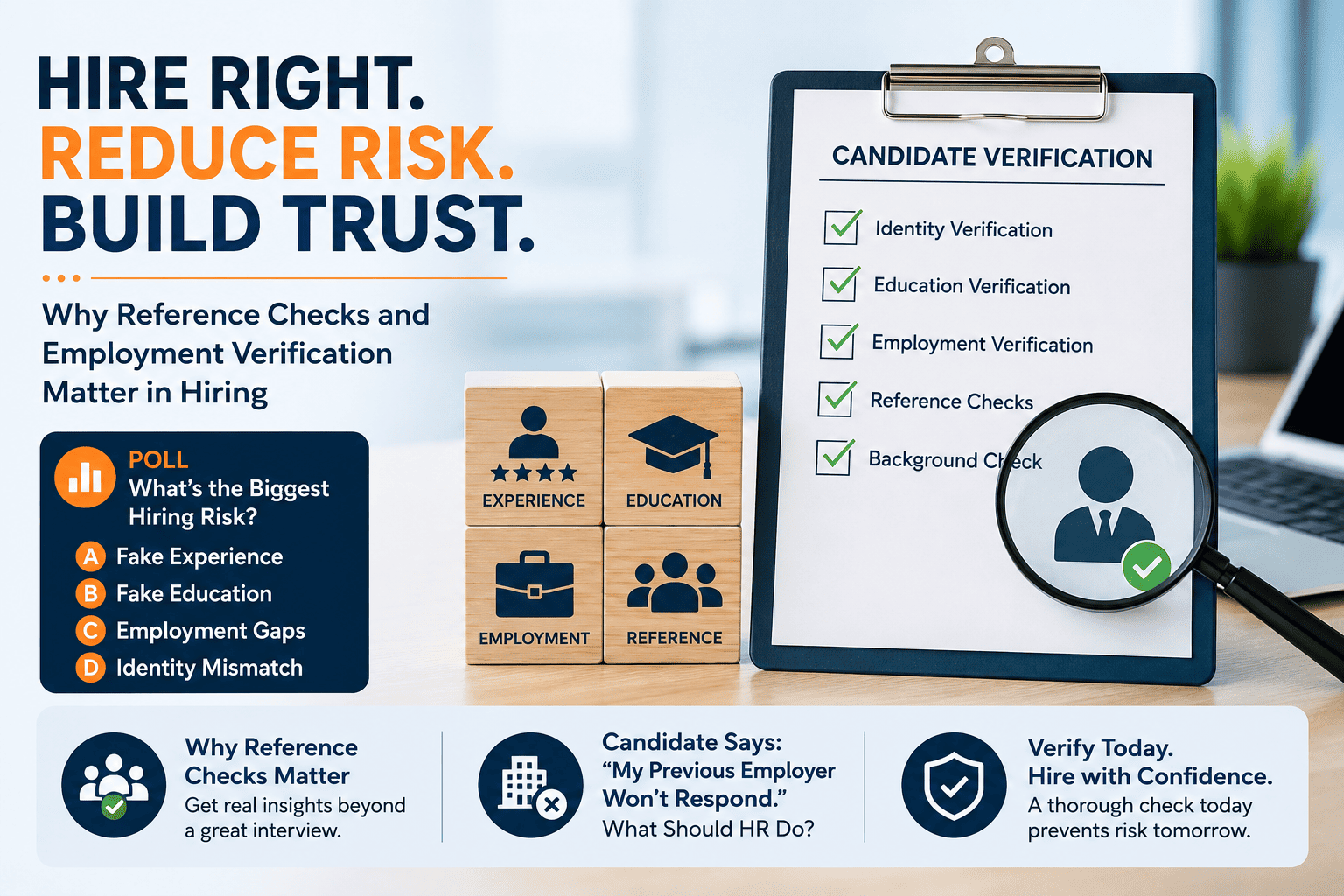
Hiring the right employee is about more than finding a candidate with an impressive résumé and a confident interview performance. A candidate may communicate exceptionally well, demonstrate strong technical knowledge, and appear to be an excellent cultural fit—yet important details about their professional history may still require verification.
This is why employment verification, education verification, reference checks, identity verification, and background verification remain important components of a responsible hiring process.
The hiring environment is also changing. Artificial intelligence is making it easier to create polished résumés, generate interview answers, alter documents, and, in some cases, impersonate another person during remote interviews. Recent reporting has highlighted growing employer concerns around AI-assisted cheating, fake identities, and deepfake candidates.
For HR teams, the objective should not be to distrust every candidate. Instead, it should be to create a consistent, proportionate, transparent, and evidence-based verification process.
What’s the Biggest Hiring Risk?
A. Fake Experience
B. Fake Education
C. Employment Gaps
D. Identity Mismatch
At first glance, all four can appear serious. However, they represent different types of hiring risk.
A. Fake Experience
A candidate may exaggerate job responsibilities, change job titles, inflate years of experience, or claim responsibility for projects they did not actually handle.
For example, someone may describe themselves as a “Senior Project Manager” when their actual position was a coordinator. Another candidate might claim experience with technologies or processes they have only encountered briefly.
Fake experience can be particularly damaging when the position involves:
- Leadership responsibilities
- Financial decision-making
- Technical expertise
- Regulatory compliance
- Confidential information
- Customer-facing responsibilities
- Safety-critical activities
Employment verification can help establish whether a candidate actually worked for the stated organization and whether basic employment details match the information provided.
B. Fake Education
Educational credentials can also be misrepresented.
Examples include:
- Claiming a degree that was never completed
- Providing incorrect graduation dates
- Misrepresenting an institution
- Claiming a qualification that does not exist
- Altering academic documents
For positions requiring specific professional qualifications, education verification can be especially important.
However, HR teams should distinguish between an intentional false claim and an honest résumé mistake. A candidate may accidentally provide an incorrect year or use an informal name for an institution without intending to deceive.
C. Employment Gaps
An employment gap is not necessarily a hiring risk.
People may have gaps because of:
- Further education
- Family responsibilities
- Career changes
- Redundancy
- Health or personal circumstances
- Relocation
- Entrepreneurship
- Sabbaticals
- Economic conditions
Therefore, employment gaps should not automatically be treated as evidence of dishonesty or poor performance.
Instead, HR should focus on whether the candidate has accurately represented their career history.
D. Identity Mismatch
Identity mismatch can be particularly concerning because it questions whether the person being evaluated is actually the person represented by the application.
Identity-related risks can include:
- Using another person’s identity
- Providing inconsistent personal information
- Mismatched documents
- Multiple identities across records
- Location inconsistencies
- Impersonation during remote interviews
The emergence of AI-generated identities and deepfake technologies has made identity assurance increasingly relevant for remote recruitment. Recent industry reporting has described organizations introducing additional live verification steps because conventional interviews may not always establish who is actually participating.
The key lesson: HR should not rely on a single verification method. A layered approach is generally more reliable.
Why Reference Checks Matter Even After a Great Interview
A strong interview tells an employer how a candidate performs during the interview.
A reference checks can provide additional context about how the candidate performed in an actual workplace.
These are two different forms of information.
During an interview, candidates naturally present their strongest qualities. They may discuss successful projects, leadership achievements, problem-solving abilities, and career accomplishments.
But an interview has limitations.
A candidate can prepare answers in advance. AI tools can make résumé writing and interview preparation easier. Interviewers may also unintentionally be influenced by confidence, communication style, or personal similarity.
A reference checks provides another perspective.
What Can a Reference Checks Help Confirm?
A properly conducted reference checks may help HR understand:
- Employment relationship
- Job title
- Approximate period of employment
- Responsibilities
- Performance
- Strengths
- Areas requiring development
- Teamwork
- Leadership ability
- Reliability
- Professional conduct
- Reason for leaving, where appropriate and lawfully obtainable
The purpose is not to find something negative about the candidate.
Instead, it is to determine whether the candidate’s claims are reasonably consistent with independent information.
Reference Checks vs. Employment Verification
These terms are sometimes used interchangeably, but they are not exactly the same.
Employment Verification: Employment verification is generally focused on factual information such as:
- Employer name
- Job title
- Start date
- End date
- Employment status
Depending on the organization and applicable laws or policies, additional information may be available.
Reference Check: A reference check generally goes further by seeking information about the candidate’s professional performance, behavior, responsibilities, and working relationship.
For example:
Employment verification: “Did this person work at your organization from 2021 to 2024?”
Reference check:
“What was it like working with this person, and what were their primary responsibilities?”
Employment verification answers “Is the employment history accurate?”
Reference checking explores “What was the candidate actually like as an employee?”
A robust hiring process may use both, depending on the role and the organization’s requirements.
Candidate Says: “My Previous Employer Won’t Respond.” What Should HR Do?
This is a common situation and should not automatically be treated as a red flag.
There are many legitimate reasons why a previous employer may not respond.
The organization may:
- Have closed down
- Have changed its HR team
- Have a policy against providing references
- Only confirm employment through an automated system
- Require formal written requests
- Have outdated contact information
- Be unwilling to provide subjective performance information
- Be located in another country or jurisdiction
Therefore, “previous employer did not respond” does not automatically mean “candidate is hiding something.”
HR should investigate systematically rather than make assumptions.
Step 1: Ask the Candidate for an Explanation
Start with a straightforward conversation.
For example:
“We were unable to obtain a response from your previous employer. Do you have an alternative HR contact, official employment verification channel, or other documentation that could help us verify your employment?”
This gives the candidate an opportunity to clarify the situation.
A genuine candidate may immediately provide:
- HR email address
- HR portal
- Former manager’s professional contact
- Employment certificate
- Experience letter
- Payslips
- Tax documents
- Offer letter
- Relieving letter
- Official company records
The specific documents that are appropriate will depend on the country, organization, role, and applicable privacy and employment laws.
Step 2: Try Alternative Verification Channels
HR should avoid relying exclusively on one contact.
Possible alternatives include:
Former Manager: If appropriate and lawful, the candidate’s former manager may be able to confirm the employment relationship or professional responsibilities.
HR Department: The company’s HR department may have a formal employment verification process.
Official Verification Portal: Some organizations use third-party or automated employment verification systems.
Corporate Email: Where appropriate, HR can verify whether the contact information appears to belong to the organization rather than relying on an unverified personal address.
Professional Licensing or Credential Bodies
For regulated professions, professional bodies may provide another method of confirming qualifications or licenses.
Step 3: Ask for Supporting Documents
If direct verification remains unsuccessful, HR can consider requesting reasonable supporting documentation.
Depending on the circumstances, examples may include:
- Experience certificate
- Relieving letter
- Appointment letter
- Payslips
- Tax documentation
- Employment contract
- Official HR correspondence
However, organizations should follow data-minimization principles and request only information genuinely relevant to the verification process.
Employees should also be cautious about submitting unnecessary sensitive information.
For example, if a document contains unrelated financial information, HR should consider whether that information is actually required before requesting or retaining it.
Step 4: Cross-Check for Consistency
HR should compare the candidate’s information across available sources.
For example:
|
Information |
Candidate’s Claim |
Verification |
|
Employer |
ABC Technologies | Matches |
|
Job Title |
Senior Analyst |
Partially matches |
|
Employment Dates |
2021–2024 |
Matches |
|
Responsibilities |
Team leadership |
Requires clarification |
|
Education |
MBA |
Verified |
| Identity | Candidate details |
Matches |
The objective is to identify material inconsistencies, not minor differences.
A one-month difference in an employment date may have a reasonable explanation.
A claim of five years of managerial experience when the employer confirms an entry-level position is much more significant.
Step 5: Give the Candidate an Opportunity to Explain
One of the most important principles in background verification is fairness.
Suppose a verification report says:
“Employment dates could not be confirmed.”
That does not necessarily mean:
“The candidate lied.”
The candidate should have an opportunity to explain.
Perhaps the employer’s records were incomplete. Perhaps the organization merged with another company. Perhaps the candidate worked through a subsidiary.
Similarly, an employee should have an opportunity to challenge inaccurate information contained in a background report.
The U.S. FTC notes that when employers use background reporting companies, applicants have specific rights under the Fair Credit Reporting Act, including procedures surrounding adverse employment decisions.
The exact legal requirements differ by jurisdiction, so HR teams should always follow the employment and privacy laws applicable to their location.
Why HR Should Avoid “No Response = Rejection”
Automatically rejecting a candidate because a previous employer did not respond can create unnecessary hiring risk.
Consider two candidates:
Candidate A: The previous employer responds immediately and confirms everything.
Candidate B: The previous employer has a strict policy of not responding to reference requests, but Candidate B provides reliable alternative documentation.
Rejecting Candidate B solely because the employer did not respond may result in losing a qualified candidate.
A better approach is to evaluate the overall evidence.
Reference Checks Should Be Consistent
One of the biggest mistakes HR teams can make is applying verification standards inconsistently.
For example:
- Candidate A receives a reference checks.
- Candidate B does not.
- Candidate C is asked for additional documents because of their nationality.
- Candidate D is not asked for the same information.
Such inconsistent practices can create fairness and compliance concerns.
The U.S. Equal Employment Opportunity Commission states that employers may conduct background checks, but they must not use background information in a way that discriminates against protected groups.
The principle is straightforward:
Use job-related verification criteria consistently.
The Role of AI in Modern Hiring Verification
Artificial intelligence is changing both sides of recruitment.
Candidates can use AI to:
- Improve résumés
- Generate cover letters
- Prepare interview answers
- Practice interviews
- Research employers
These uses are not necessarily fraudulent.
At the same time, technology can also be misused to:
- Create fabricated credentials
- Manipulate documents
- Generate fake identities
- Impersonate candidates
- Produce synthetic interview responses
Recent reporting has highlighted the growing concern around “deepfake employees” and identity impersonation in remote hiring environments.
This does not mean employers should treat AI as inherently suspicious.
Instead, HR teams should focus on authenticity and evidence.
For example, employers can combine:
- Structured interviews
- Skills assessments
- Identity verification
- Employment verification
- Education verification
- Reference checks
- Role-specific background checks
- Human review of exceptions
No single tool can eliminate hiring risk completely.
A Practical Hiring Verification Framework for HR
A strong process can be organized into five stages.
1. Identity: Confirm that the applicant is the person applying for the role.
2. Qualifications: Verify education, certifications, licenses, and other required credentials.
3. Employment: Confirm previous employment and relevant career history.
4. References: Where appropriate, obtain professional references to understand workplace performance and conduct.
5. Risk Review: Assess discrepancies in context and give candidates a reasonable opportunity to clarify material inconsistencies.
This approach is more useful than simply trying to “catch” candidates.
What Employees and Job Seekers Should Do
Background verification is not only an HR responsibility. Employees can reduce delays by keeping their professional records accurate.
Before applying for a new job, candidates should check:
- Résumé employment dates
- Job titles
- Company names
- Educational qualifications
- Certification details
- Professional licenses
- Contact information for former employers
- Reference contact details
Candidates should also avoid exaggerating responsibilities.
It is better to say: “Supported a team of five”
than to claim: “Managed a team of five”
if the candidate did not actually have management responsibility. Accuracy builds trust.
What Makes a Good Reference Check?
A good reference checks should be:
Relevant: Focus on information related to the position.
Consistent: Apply the same process to comparable candidates.
Documented: Keep appropriate records of the verification process.
Proportionate: Request information that is genuinely necessary.
Transparent: Inform candidates about verification requirements where appropriate.
Fair: Give candidates an opportunity to clarify significant discrepancies.
Lawful: Follow applicable employment, privacy, anti-discrimination, and background-check requirements.
The objective is not to conduct an unlimited investigation into someone’s personal life.
The objective is to establish whether the candidate’s professional qualifications and employment claims are credible and relevant to the role.
Final Thoughts: Trust, But Verify
A great interview is a positive signal—but it should not necessarily be the final piece of the hiring puzzle.
Fake experience, fake education, unexplained inconsistencies, and identity mismatches can create serious organizational risks. At the same time, employment gaps, non-responsive employers, or minor discrepancies should not automatically be interpreted as evidence of dishonesty.
The most effective approach is a layered background verification process that combines identity verification, employment verification, education verification, reference checks, skills assessment, and appropriate human judgment.
For HR professionals, the goal should be to make hiring decisions based on reliable evidence rather than assumptions.
For employees and job seekers, the best protection is accuracy, transparency, and keeping professional records consistent.
As recruitment becomes increasingly digital—and as AI makes both legitimate recruitment and fraudulent activity more sophisticated—reference checks and employment verification remain valuable because they add an independent layer of evidence to the hiring decision.
Ultimately, good hiring is not about assuming every candidate is a risk.
It is about creating a process that allows organizations to verify what matters, identify genuine concerns, treat candidates fairly, and make better-informed hiring decisions.