
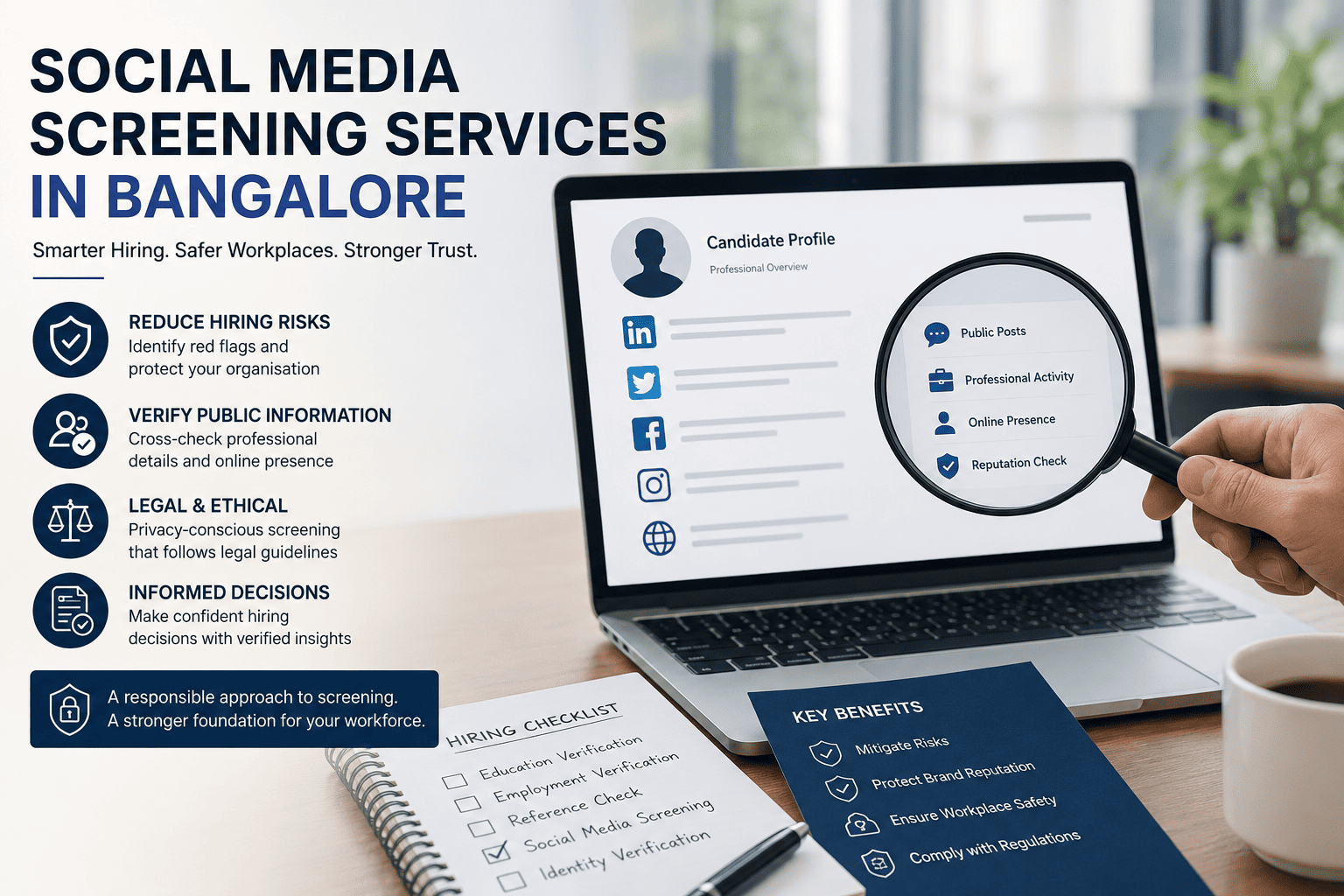
Hiring the right employee is one of the most important decisions a company makes. Whether it is an IT professional joining a technology company, a healthcare worker handling sensitive patient information, a senior executive representing a brand, or a customer-facing employee interacting with clients, the hiring decision can directly influence business performance, reputation, compliance and workplace safety.
Traditional background verification usually focuses on identity, education, employment history, address, criminal records and professional references. However, in today’s digital-first environment, a candidate’s publicly available online presence can also provide additional context about their professional conduct, communication style and digital footprint.
This is where social media screening services in Bangalore are becoming increasingly relevant for employers across industries.
Social media screening is a structured process of reviewing publicly available online information associated with a candidate, while following appropriate legal, privacy and ethical safeguards. It is not about invading a candidate’s private life or judging someone based on personal opinions. Instead, responsible screening focuses on relevant, verifiable and job-related information that may help organizations make more informed recruitment decisions.
For companies operating in Bangalore’s highly competitive technology, startup, healthcare, education, financial services, retail, pharmaceutical, manufacturing and professional services sectors, social media screening services in Bangalore can become an important part of a comprehensive employee background verification process.
What Is Social Media Screening?
Social media screening services involves reviewing publicly available online information connected to a candidate’s professional or public digital presence.
Depending on the scope of the assignment and the organization’s requirements, the screening process may consider:
- Public professional profiles
- Publicly visible social media activity
- Public posts, comments or content relevant to workplace conduct
- Online professional claims and publicly available information
- Potential inconsistencies in publicly presented professional information
- Evidence of impersonation or fraudulent digital identities
- Public information relevant to specific risk-sensitive roles
The purpose is not to monitor private accounts, access restricted content or make assumptions based on personal characteristics.
A professional screening process should be structured, objective, proportionate and relevant to the role. The information identified during screening should be assessed carefully and, wherever appropriate, verified through reliable sources rather than treated as automatic proof of misconduct.
This distinction is important. Social media screening should support a broader background verification process, not replace professional judgment or become an unregulated form of online surveillance.
Why Are Companies Increasingly Considering Social Media Screening Services in Bangalore?
Bangalore is one of India’s largest employment markets, with a diverse ecosystem of technology companies, startups, global capability centers, fintech companies, healthcare organizations, educational institutions and service businesses.
This environment has also created new hiring risks.
Companies may face challenges such as:
- Misrepresentation of qualifications
- Falsified professional experience
- Fake online identities
- Misleading professional claims
- Reputation risks involving public conduct
- Fraudulent candidate profiles
- Inconsistencies between a candidate’s application and public professional information
At the same time, digital platforms have become an important part of professional identity. A candidate’s online presence may provide additional information about their public professional reputation and communication patterns.
This is particularly relevant for roles involving:
- Public representation of a company
- Customer communication
- Leadership and executive responsibilities
- Access to sensitive data
- Financial responsibility
- Healthcare and patient interaction
- Education and child-facing roles
- Cybersecurity and technology
- High-trust or compliance-sensitive positions
However, the objective should always be to identify job-relevant risks, not to make decisions based on personal preferences or protected characteristics.
Social Media Screening Must Be Conducted with Privacy in Mind
The legal and compliance environment surrounding personal data in India is evolving rapidly.
The Digital Personal Data Protection Act, 2023, together with the Digital Personal Data Protection Rules, 2025, has created a more formal framework for responsible processing of digital personal data. The Rules were notified in November 2025, giving operational effect to the broader data protection framework. The framework emphasizes responsible data use, transparency, security safeguards and individual rights.
For companies considering social media screening services in Bangalore, this means that data collection and processing should not be treated casually.
Organizations should consider the following principles:
- Purpose Limitation
Before conducting screening, an organization should have a clear and legitimate purpose.
For example, screening for a senior executive position with significant reputational responsibilities may have a different scope from screening for a role with no public-facing responsibilities.
The screening should be connected to a legitimate recruitment, risk management or compliance objective.
- Data Minimization
More information is not necessarily better information.
A responsible screening process should focus on information that is relevant to the purpose of the assessment. Collecting excessive personal information can create unnecessary privacy, security and compliance risks.
- Transparency
Candidates should be informed appropriately about relevant background verification activities and the processing of their personal data.
Companies should maintain clear internal policies explaining:
- What information may be reviewed
- Why the information is processed
- Who may access the information
- How long information may be retained
- How findings are handled
- Security
Screening reports may contain sensitive personal information. Companies and service providers must therefore take appropriate measures to protect such information against unauthorized access, disclosure or misuse.
The 2025 Rules specifically strengthen expectations around responsible data management, security safeguards, breach response and organizational accountability.
Important: The exact legal obligations applicable to a specific organization, processing activity or employment situation may depend on the facts and applicable law. Companies should obtain qualified legal advice for their individual compliance requirements.
What Are the Latest Trends in Social Media Screening?
-
Greater Focus on Privacy-Compliant Screening
One of the most significant trends is the shift from informal online searches to structured, documented and privacy-conscious screening.
Companies are increasingly asking:
- Was the information publicly available?
- Was it relevant to the job?
- Was the information accurately attributed to the candidate?
- Was the data collected for a legitimate purpose?
- Was the information stored securely?
- Was the decision based on verified facts?
This is a major improvement over unstructured searches conducted by individual recruiters.
-
AI-Assisted Screening with Human Oversight
Artificial intelligence and automation are influencing the background verification sector.
Technology can help with:
- Identifying publicly available information
- Organizing large volumes of data
- Detecting potential inconsistencies
- Identifying duplicate or potentially fraudulent profiles
- Supporting risk categorization
However, AI-generated results should not automatically determine whether a candidate is hired or rejected.
AI systems can produce inaccurate results, misunderstand context or incorrectly associate information with an individual. Human review and verification remain essential.
The emerging trend is therefore not simply “AI screening”, but rather technology-assisted screening with human oversight.
-
Increased Focus on Identity and Authenticity
Fake profiles, impersonation and misleading online identities are growing concerns in digital recruitment.
Modern screening processes increasingly focus on verifying whether publicly available information can reasonably be associated with the correct individual.
This may be particularly relevant for:
- Senior professionals
- Remote employees
- Technology professionals
- Sales and business development roles
- Public-facing executives
- Influencers and brand representatives
Identity verification should always be conducted responsibly and in accordance with applicable legal and privacy requirements.
-
Screening Is Becoming More Role-Specific
A one-size-fits-all screening approach is becoming less effective.
A technology company may focus on risks relevant to access to systems and confidential information. A healthcare organization may have different requirements. A financial services organization may have stricter compliance expectations.
Therefore, modern social media screening services in Bangalore is increasingly being designed around:
- The responsibilities of the position
- The level of seniority
- Industry-specific risks
- Access to confidential information
- Public-facing responsibilities
- Regulatory expectations
This approach is more practical and helps reduce irrelevant or discriminatory decision-making.
How Can Social Media Screening Help Different Industries?
IT and Technology: Technology companies often handle confidential data, intellectual property and client information. Screening can form part of a broader risk-based employee verification programme.
Healthcare: Hospitals, clinics and healthcare companies may require comprehensive screening for roles involving patient interaction and access to sensitive information.
Financial Services: Banks, fintech organizations and financial service providers operate in high-trust environments. Employee screening can support broader fraud prevention and risk management processes.
Education: Schools, universities and education technology companies may require robust screening for employees interacting with students and institutions.
Retail and E-commerce: Customer-facing employees can influence brand reputation. Screening may be relevant for roles involving customer service, sales, corporate communications and management.
Pharmaceutical and Manufacturing: These sectors often involve intellectual property, confidential business information and regulated processes. Background verification can support responsible workforce management.
Startups: Fast-growing startups frequently recruit quickly. A structured screening process can help reduce the risk of hiring based solely on an impressive resume or interview performance.
Also Read: Top Challenges Faced by Startups in Employee Background Checks—and How to Solve Them
What Should Companies Avoid During Social Media Screening?
Responsible screening requires clear boundaries.
Companies should avoid:
- Accessing private social media accounts without proper authority
- Requesting personal passwords
- Making decisions based solely on political, religious or personal opinions
- Discriminating based on protected personal characteristics
- Treating unverified online content as fact
- Using anonymous or unreliable information as conclusive evidence
- Collecting excessive personal data
- Allowing automated tools to make final hiring decisions without human review
A candidate should not be rejected simply because a recruiter disagrees with a lawful personal opinion or lifestyle choice.
The key question should always be:
Is the information relevant, reliable, legally obtained and connected to the requirements of the role?
Why Work with Professional Social Media Screening Services in Bangalore?
Internal recruiters may not always have the time, expertise or methodology required to conduct consistent online screening across a large volume of candidates.
A professional screening provider can help organizations develop a more structured process that includes:
- Defined screening parameters
- Public-source research methodology
- Identity matching and verification
- Relevant information categorization
- Quality control
- Report documentation
- Privacy-conscious data handling
- Human review of findings
For companies hiring at scale, outsourcing this process can also improve consistency and allow internal HR teams to focus on recruitment, onboarding and employee experience.
A professional provider should not simply collect information. The value lies in responsible research, contextual analysis and clear reporting.
The Future of Social Media Screening in India
Social media screening is likely to become more sophisticated as hiring becomes increasingly digital.
Future trends may include:
- Greater integration with employee background verification platforms
- Improved identity matching technology
- AI-assisted information classification
- Stronger privacy controls
- More role-specific screening frameworks
- Increased demand for audit trails
- Greater focus on explain ability and human review
- Integration with broader fraud prevention programmes
At the same time, data protection and privacy expectations will continue to influence how organizations conduct screening.
India’s evolving data protection framework means that companies should prepare for a future where personal data processing is increasingly subject to transparency, accountability and security expectations. The DPDP Rules, 2025 provide a significant regulatory development in this direction, with phased implementation and an operational framework for responsible personal data use.
Conclusion
Social media screening can provide valuable insights as part of a comprehensive employee background verification strategy. However, it should never become an excuse for intrusive surveillance or subjective judgment.
For companies in Bangalore and across India, the most effective approach combines:
- A clear purpose
- Role-relevant screening
- Reliable information sources
- Human verification
- Data minimization
- Privacy-conscious practices
- Appropriate security safeguards
- Consistent documentation
As digital identities become increasingly connected to professional reputation, companies need better ways to understand potential risks before making important hiring decisions.
Dcode Research provides professional background verification and employee screening solutions designed to help organizations make more informed hiring decisions. Through a structured approach to candidate verification and risk assessment, businesses can strengthen their recruitment processes while building a culture of trust, compliance and responsible hiring.
Hire with confidence. Verify with clarity.
Frequently Asked Questions
What are social media screening services in Bangalore?
Social media screening services in Bangalore involve the structured review of publicly available online information related to a candidate as part of a broader background verification process.
Is social media screening legal in India?
The legality and compliance requirements depend on how the information is collected, processed and used. Organizations should follow applicable data protection, privacy and employment laws and ensure that screening is relevant, proportionate and responsibly conducted.
Does social media screening involve accessing private accounts?
A responsible screening process should focus on publicly available information and should not involve unauthorized access to private accounts or passwords.
Can social media screening replace traditional background verification?
No. Social media screening should complement, not replace, identity, education, employment, address and other relevant background verification checks.
Which companies can benefit from social media screening services in Bangalore?
Companies across IT, healthcare, finance, education, retail, pharmaceuticals, manufacturing, startups and other sectors may consider social media screening where it is relevant to the role and conducted responsibly.
How can companies ensure fair social media screening?
Companies should use standardized screening criteria, focus on job-relevant information, verify findings, avoid discriminatory decision-making and maintain appropriate privacy and data protection safeguards.