
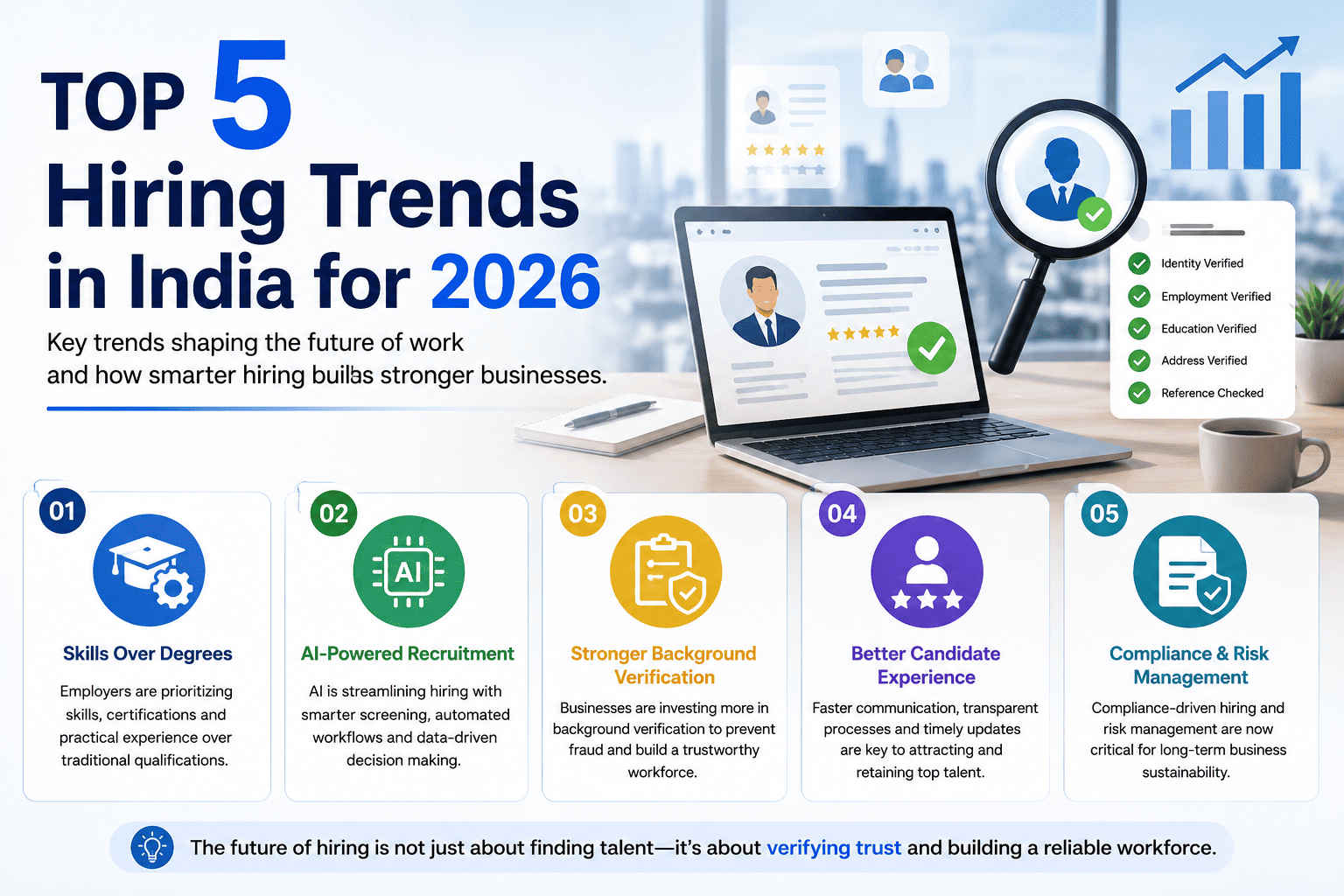
The Indian job market is evolving at an unprecedented pace. Rapid digital transformation, artificial intelligence, hybrid work models, and increasing cases of hiring fraud are changing the way organizations recruit talent. Companies are no longer focused solely on filling vacancies—they are investing in hiring employees who are skilled, trustworthy, and aligned with long-term business goals.
Whether you’re a startup, SME, or large enterprise, understanding the latest hiring trends can help you improve recruitment quality, reduce hiring risks, and strengthen your workforce.
In this article, we’ll explore the top five hiring trends in India for 2026 and explain why employee background verification has become an essential part of modern recruitment.
Hiring Trends in India for 2026:
-
Skills-Based Hiring Is Replacing Traditional Hiring Methods
The days when employers hired primarily based on academic qualifications are gradually fading.
Today’s organizations are looking for candidates who can demonstrate practical knowledge, adaptability, and measurable achievements. Hiring managers increasingly value portfolios, industry certifications, internships, technical assessments, and project experience over degrees alone.
This approach enables businesses to identify talent that can contribute immediately while encouraging continuous learning among employees.
Why this matters
- Better workforce productivity
- Faster onboarding
- Improved job performance
- Greater innovation
However, as companies shift toward skills-first hiring, verifying educational qualifications and professional certifications remains essential. Employers should ensure that every claimed qualification is authentic before making hiring decisions.
-
AI Is Transforming Recruitment Processes
Artificial Intelligence is becoming one of the most influential technologies in recruitment.
Recruiters now use AI-powered tools for:
- Resume screening
- Candidate ranking
- Interview scheduling
- Talent matching
- Recruitment analytics
- Candidate engagement
These technologies reduce manual effort and significantly shorten recruitment cycles.
But AI has limitations
AI can analyze resumes quickly, but it cannot verify whether the information provided by candidates is genuine.
Employment history, educational qualifications, identity documents, criminal records, and references still require professional verification.
Businesses that combine AI recruitment with reliable background verification create a recruitment process that is both efficient and secure.
-
Employee Background Verification Is Becoming Standard Practice
One of the biggest hiring trends in India during 2026 is the growing importance of background verification.
Organizations understand that one incorrect hiring decision can lead to financial losses, operational disruption, legal complications, and reputational damage.
Modern employee background verification generally includes:
- Identity Verification
- Employment Verification
- Education Verification
- Address Verification
- Criminal Record Check
- Reference Verification
- Database Screening
Why background verification matters
Hiring fraud continues to increase across multiple industries.
Some candidates may:
- Exaggerate job responsibilities
- Submit fake experience letters
- Provide incorrect employment dates
- Present forged educational certificates
- Hide previous employment issues
A structured background verification process helps employers identify discrepancies before onboarding, reducing hiring risks and protecting the organization.
-
Candidate Experience Influences Hiring Success
Top professionals often receive multiple job offers.
A slow recruitment process can result in losing highly qualified candidates to competitors.
Companies are improving candidate experience by offering:
- Faster interview scheduling
- Clear communication
- Digital documentation
- Simplified onboarding
- Transparent hiring timelines
Creating a positive recruitment journey strengthens employer branding and improves offer acceptance rates.
However, improving candidate experience should never mean skipping important verification steps.
Businesses that integrate verification into their hiring workflow can maintain speed without compromising trust.
-
Compliance and Risk Management Are Driving Hiring Decisions
Regulatory compliance has become a significant priority for employers across India.
Organizations must ensure that employees satisfy legal and organizational requirements before joining the workforce.
Industries such as:
- Information Technology
- Banking and Financial Services
- Healthcare
- Manufacturing
- Logistics
- E-commerce
- Education
are strengthening recruitment compliance through comprehensive background screening.
Compliance-focused hiring helps organizations:
- Reduce legal exposure
- Prevent internal fraud
- Improve workplace security
- Protect confidential information
- Maintain client confidence
Hiring decisions are increasingly based on both competence and credibility.
Why Hiring Fraud Is Increasing
Recruitment has become more competitive than ever.
As candidates compete for limited opportunities, some resort to misrepresenting information to improve their chances of selection.
Common examples include:
- Fake resumes
- Incorrect salary details
- Fabricated work experience
- Forged educational certificates
- False references
- Hidden employment gaps
Without proper verification, these discrepancies may go unnoticed until after the employee has joined the organization.
By then, the financial and operational costs can be significant.
The Cost of a Bad Hire
A poor hiring decision affects more than just recruitment budgets.
It can result in:
- Reduced team productivity
- Increased employee turnover
- Training costs
- Project delays
- Customer dissatisfaction
- Data security risks
- Compliance violations
- Damage to employer reputation
Investing in professional background verification is significantly more cost-effective than replacing the wrong employee.
Best Practices for Hiring in 2026
Organizations looking to improve recruitment outcomes should adopt these best practices:
Define clear hiring requirements: Identify the skills, experience, and competencies required before beginning recruitment.
Use structured interviews: Standardized interview processes improve hiring consistency and reduce bias.
Verify candidate information: Always validate education, employment history, identity, and references before onboarding.
Combine AI with human expertise: Automation improves efficiency, while experienced HR professionals make informed hiring decisions.
Maintain compliance: Ensure hiring practices comply with industry regulations and internal governance policies.
How Background Verification Supports Business Growth
Reliable employee screening offers benefits beyond recruitment.
Organizations that invest in verification often experience:
- Better hiring quality
- Reduced employee fraud
- Improved compliance
- Higher client confidence
- Stronger workplace culture
- Lower attrition
- Improved operational stability
Conclusion
Hiring in 2026 is no longer just about finding qualified candidates. It is about selecting individuals whose credentials, experience, and integrity have been verified.
As hiring becomes faster and more technology-driven, organizations must balance efficiency with accuracy. Skills-based hiring, AI-powered recruitment, enhanced candidate experience, and compliance-focused recruitment are shaping the future of India’s workforce—but background verification remains the foundation that supports them all.
Businesses that strengthen their hiring process today will be better prepared to reduce risk, improve workforce quality, and build long-term success.
Looking for a trusted background verification partner?
Dcode Research provides comprehensive employee background verification services, including identity verification, employment verification, education verification, criminal record checks, address verification, and reference checks. Our fast, accurate, and compliant screening solutions help organizations hire with confidence and build teams they can trust.
Ready to make safer hiring decisions? Contact Dcode Research today and strengthen your recruitment process with reliable background verification services.
Frequently Asked Questions (FAQs)
- What are the biggest hiring trends in India in 2026?
The biggest hiring trends in India in 2026 include skills-based hiring, AI-powered recruitment, increased employee background verification, improved candidate experience, and compliance-driven hiring. Companies are focusing on hiring qualified and trustworthy candidates while making recruitment faster and more efficient.
- Why are hiring trends shifting toward skills-based recruitment?
Modern hiring trends show that employers value practical skills, certifications, and real-world experience more than academic qualifications alone. This approach helps organizations build high-performing teams capable of adapting to changing business needs while reducing skill gaps.
- How does background verification support modern hiring trends?
One of the most important hiring trends is the growing emphasis on employee background verification. Verifying identity, education, employment history, criminal records, and references helps organizations reduce hiring fraud, improve compliance, and make confident recruitment decisions.
- How is Artificial Intelligence influencing hiring trends?
AI is transforming hiring trends by automating resume screening, candidate matching, interview scheduling, and recruitment analytics. While AI improves hiring efficiency, employers should combine it with professional background verification to ensure candidate information is accurate and trustworthy.
- How can businesses adapt to the latest hiring trends in 2026?
To stay ahead of evolving hiring trends, businesses should adopt AI-powered recruitment tools, focus on skills-based hiring, streamline the candidate experience, implement comprehensive background verification, and maintain compliance with employment regulations. These practices help organizations attract top talent while minimizing hiring risks.